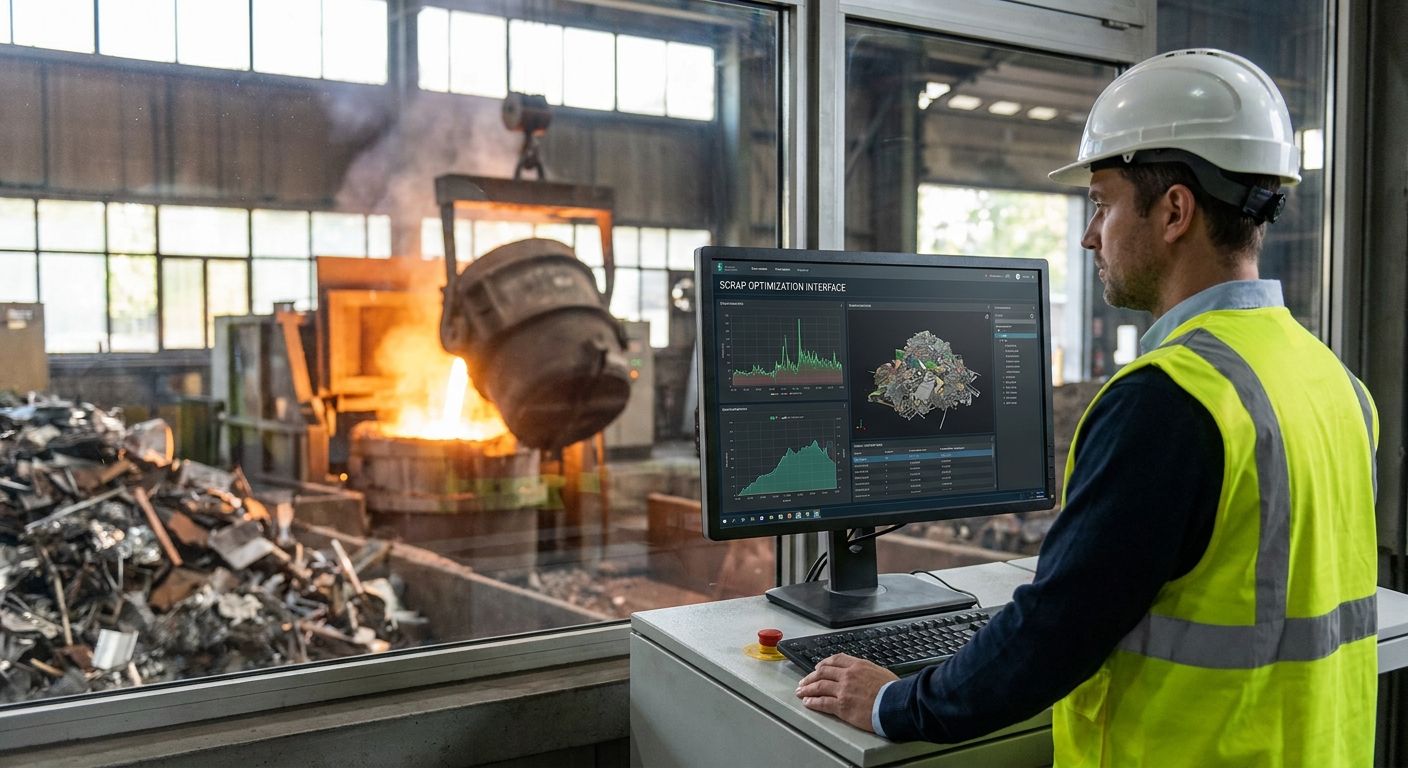
Scrap optimization software for steel mills in 2026 turns weight tickets, chemistry certs, and market price feeds into a live charge-mix model, so buyers stop guessing which grade to load into the next heat. The category exists because scrap is the single biggest variable cost lever an electric arc furnace mill controls, and a mill that manages it by spreadsheet leaves yield and money on the table every shift.
- Scrap optimization software for steel mills replaces manual grading spreadsheets with a live charge-mix model tied to melt specs.
- Metal Minds' OptiScrap is best for EAF mills that need chemistry-to-charge matching without a full ERP overhaul.
- Manual scrap grading still works for single-furnace shops under one melt schedule; it breaks down past two grades per heat.
- Buy scrap optimization software once your mill juggles more than three scrap suppliers or two furnace chemistries.
- Common failure: buying software before fixing yard-level weight and grade data capture.
Why scrap optimization software matters for steel mills
Scrap accounts for the largest single variable cost in EAF steelmaking, and its price and chemistry both move faster than most procurement teams can track by hand. A mill buying shredded scrap, busheling, and pig iron from five yards is really managing five moving chemistry profiles against one furnace spec, and every mismatch shows up as extra alloy addition, longer tap-to-tap time, or off-spec chemistry that gets discounted at the ladle.
Steel mills running EAFs feel this differently than integrated BOF shops. An EAF melt shop changes charge mix heat to heat, which means the optimization problem is continuous, not a monthly buying decision. That's the gap scrap optimization software for steel mills is built to close: it turns scrap buying and charging into one connected data flow instead of two disconnected jobs run by two different teams.
The Metal Minds platform approaches this as a scheduling and chemistry problem first, procurement second — which matters because most mills that fail at scrap optimization software adoption bought a purchasing tool when what they needed was a melt-shop planning tool.
Audit your current scrap grading process
Before any software conversation, find out what your yard actually knows about the scrap coming in. Most mills discover gaps here that no software fixes on day one.
- Pull the last 90 days of receiving tickets and check how many lack a chemistry estimate at intake
- Compare grader call sheets against actual furnace chemistry results for the same heats
- Flag suppliers whose delivered grade consistently drifts from the ordered grade
- Check whether tramp element tracking (copper, tin, chromium) happens at receiving or only after tap
- Note how many grading decisions rely on one person's visual judgment with no backup
Map scrap chemistry to melt specs
Once you know what's coming in, connect it to what the furnace actually needs. This is where manual mills hit a wall — matching five scrap grades against three product specs by hand doesn't scale past a handful of SKUs.
- Build a chemistry range table for every product grade you melt, not just the top three
- List tramp element ceilings per spec and flag which scrap grades routinely violate them
- Identify which grades can substitute for each other without a re-spec conversation
- Document current dilution assumptions used for pig iron and DRI blends
- Set a tolerance band for each element so grading calls have a numeric backstop, not just judgment
At this stage, a mill with more than two or three concurrent melt specs typically can't hold this mapping current by hand. That's the point where scrap optimization software for steel mills — Metal Minds' OptiScrap module in particular — starts paying for itself, because it recalculates the chemistry match every time a new lot hits the yard scale instead of once a week in a review meeting.
Automate supplier scoring and yard tracking
Supplier quality varies more than most procurement teams admit, and manual scorecards go stale fast.
- Score suppliers on grade-accuracy rate, not just delivered tonnage
- Track rejection and downgrade rates per supplier over rolling 90-day windows
- Flag price-versus-chemistry-quality tradeoffs instead of buying on price alone
- Set automatic reorder triggers tied to yard inventory levels by grade
- Route low-scoring suppliers to a secondary approval step before purchase orders go out
Build a scrap-to-charge mix model
This is the step that separates mills getting real savings from mills that bought software and kept working the old way. The model has to run per heat, not per week.
- Feed live yard inventory by grade and chemistry into the mix calculation
- Weight the model against current scrap market pricing, not last month's contract price
- Constrain the model to furnace capacity, tap schedule, and alloy addition limits
- Run a what-if scenario before committing to a purchase order, not after
- Recalculate the optimal mix whenever a new price feed or inventory count lands
CoreMelt, Metal Minds' melt-operations app, plugs into this step so the charge-mix recommendation updates against furnace conditions in near real time rather than a static plan built that morning.
Integrate scrap data with production scheduling
Scrap optimization only pays off if the buying calendar and the tap schedule agree with each other.
- Sync scrap delivery windows with planned furnace campaigns
- Flag scheduling conflicts where a needed grade won't arrive before a scheduled heat
- Share chemistry forecasts with the scheduling team, not just procurement
- Build a rolling 2-week buy plan tied to the confirmed production calendar
- Use SmartPlan-style scheduling logic to reorder heats around scrap availability instead of the reverse
Track cost-per-ton savings and yield loss
Without a baseline, nobody can prove the software worked. Set this up before rollout, not after.
- Record cost-per-ton-of-liquid-steel for at least one full quarter before any software change
- Track yield loss attributable to off-spec chemistry separately from mechanical yield loss
- Log alloy addition cost per heat as its own line item
- Compare tap-to-tap time before and after chemistry-matched charging
- Review the numbers monthly with both procurement and melt-shop leads in the room
Choose the right software tier for your mill size
Not every mill needs the same depth of tooling, and buying more than the operation can use wastes budget and adoption momentum.
| Option | Best for | Key limitation |
|---|---|---|
| Manual spreadsheet grading | Single-furnace shops with one or two melt specs | Breaks down past three concurrent scrap grades |
| Generic ERP scrap module | Mills that already run ERP and just need basic tracking | No real-time chemistry-to-charge matching |
| Standalone yard management software | Yards focused on receiving and inventory accuracy | Doesn't connect to furnace scheduling or melt specs |
| Metal Minds' OptiScrap platform | EAF mills juggling multiple grades, suppliers, and melt specs | Requires clean receiving data to deliver full value |
Verdict: Metal Minds' OptiScrap is the strongest fit for EAF mills running three or more melt specs against multiple scrap suppliers — mills with a single furnace and one steady spec are better served by disciplined manual grading in 2026.
See how OptiScrap fits your mill
Check current scrap-to-charge modeling capabilities for your operation.
Common mistakes steel mills make with scrap optimization
- Buying software before fixing data capture — a chemistry-matching model is only as good as the receiving-ticket data feeding it
- Letting procurement and melt-shop scheduling run on separate calendars — the best charge mix on paper is worthless if the grade isn't on-site for the scheduled heat
- Scoring suppliers on price alone — a cheap grade that misses chemistry specs costs more in alloy additions than it saves at the scale
- Skipping the baseline measurement — mills that don't track cost-per-ton before rollout can't prove the software's impact to plant leadership afterward
- Treating tramp elements as a once-a-quarter review — copper and tin creep in gradually and only show up as a problem after a customer rejects a heat
FAQ
What does scrap optimization software actually do for a steel mill?
It matches incoming scrap chemistry and inventory against furnace melt specs in real time, recommending the lowest-cost charge mix that still hits spec. It replaces manual grading spreadsheets that can't keep up once a mill runs more than two or three concurrent melt specs.
Is scrap optimization software worth it for a single-furnace mill?
Not always. A mill running one furnace against one or two steady melt specs can manage grading manually in 2026 without losing much efficiency. The software pays off once suppliers, grades, or product specs multiply past what one grader can track by hand.
How is scrap optimization different from a scrap yard management system?
Yard management software tracks receiving and inventory; scrap optimization software connects that inventory to furnace chemistry requirements and recommends the actual charge mix. A mill can have accurate yard tracking and still be optimizing nothing if the two systems don't talk to each other.
Does scrap optimization software replace the need for a scrap buyer?
No. It gives the buyer a chemistry-weighted view of what to purchase and when, but supplier relationships, contract negotiation, and market judgment still sit with the human buyer. The software removes the manual math, not the buying decision.
What data does a mill need before implementing scrap optimization software?
At minimum: consistent chemistry estimates at receiving, a documented melt-spec chemistry range table, and a rolling yard inventory count by grade. Mills that skip the data audit step typically see slower payback because the model is only as accurate as what feeds it.
Can scrap optimization software reduce alloy addition costs?
Yes, indirectly — by charging a scrap mix that's already closer to the target chemistry, the furnace needs fewer and smaller alloy corrections per heat. The savings show up as a lower alloy-cost-per-ton line item, which is why tracking that metric before and after rollout matters.
How long does it take to see results from scrap optimization software in 2026?
Mills with clean receiving data and an established melt-spec table typically see measurable yield and cost-per-ton improvement within the first full production quarter. Mills that need to fix data capture first should expect that cleanup to take longer than the software rollout itself.
One last thing
The mills that get the fastest payback from scrap optimization software don't start by shopping for a tool — they start by syncing the buying calendar with the tap schedule, because a perfectly modeled charge mix that arrives a day late is worthless. Fix that alignment first in 2026, then let scrap optimization software for steel mills handle the chemistry math.